|
I am currently pursuing the Ph.D. degree in information engineering at King's College London, U.K., supervised by Prof. Osvaldo Simeone. Previousely, I received my M.Eng. degree in Electronics and Communication Engineering from South China University of Technology in 2022, where I was advised by Prof. Jie Tang and Dr. Arman Shojaeifard. I've had the privilege of collaborating with Dr. Nicola Paoletti from the Department of Informatics at King's and Dr. Sangwoo Park from Imperial College London. Email / Google Scholar / Github / LinkedIn |
|
|
|
My research focuses on reliable inference, with a particular emphasis on the co-design of reliability and efficiency through Bayesian learning, conformal prediction, and collaborative inference. Prior to this, I worked on the system-level performance analysis of UAV-assisted communication systems. |
|
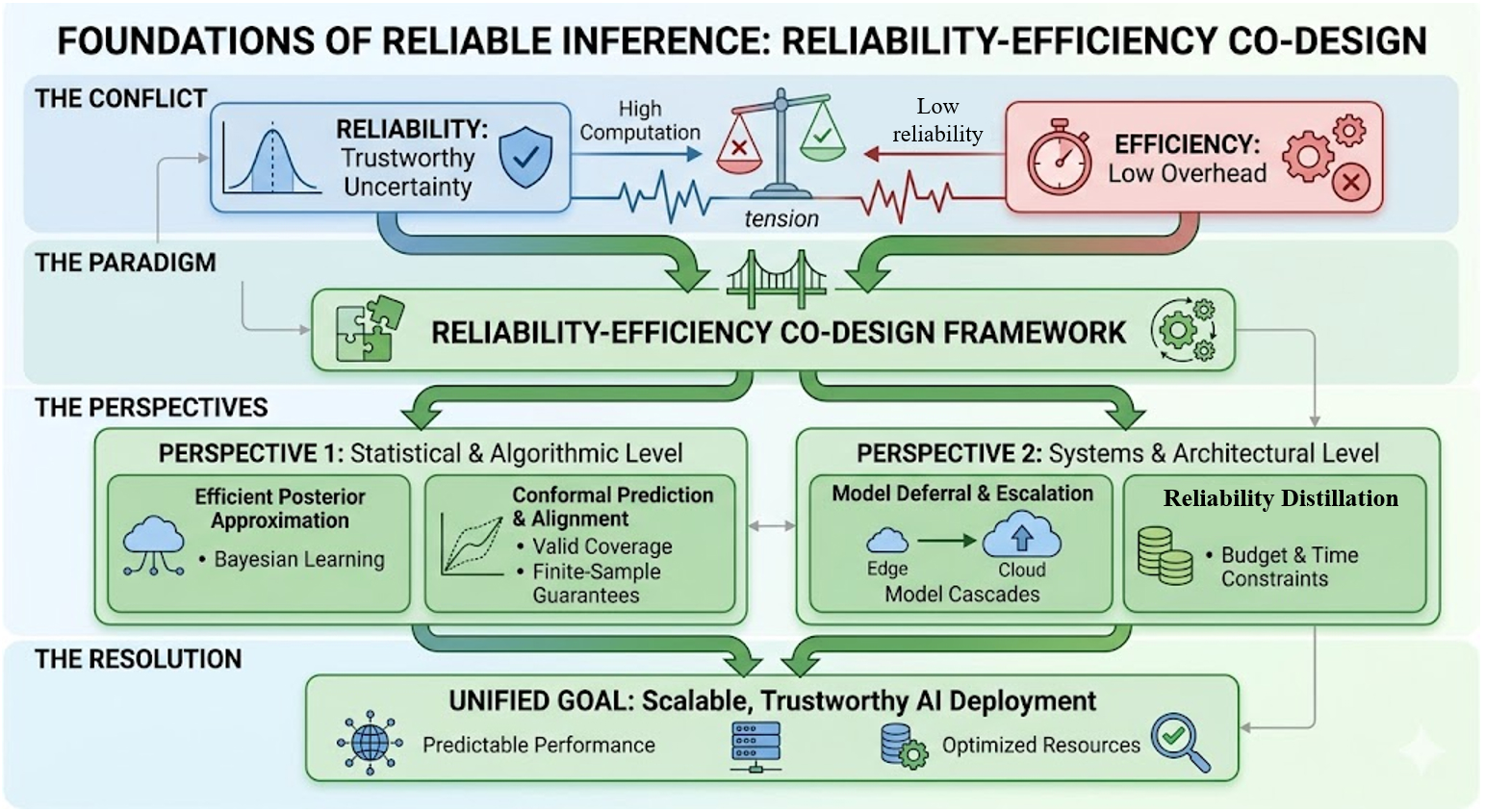
Jiayi Huang PhD Thesis arXiv Reliable inference requires that artificial intelligence (AI) models provide trustworthy uncertainty estimates, not merely accurate predictions. Recent advances in Bayesian learning have made significant progress toward this goal, and growing concerns about computational overhead have jointly shifted the design criterion from reliability alone to the co-design of reliability and efficiency, i.e., reducing computational overhead while preserving trustworthy uncertainty quantification. This thesis develops a unified framework from two perspectives to address the central question: can we efficiently perform reliable inference? |
|
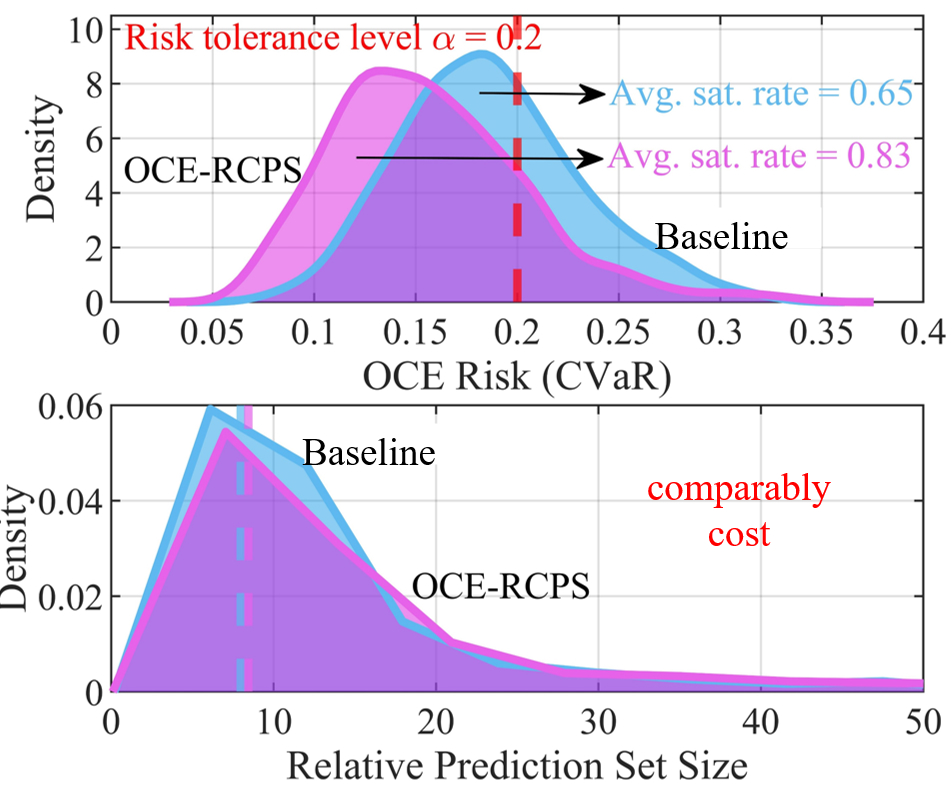
Jiayi Huang, Amirmohammad Farzaneh, Osvaldo Simeone EUSIPCO, 2026 arXiv / code We introduce optimized certainty equivalent RCPS (OCE-RCPS), a novel framework that provides high-probability guarantees on general optimized certainty equivalent (OCE) risk measures, including conditional value-at-risk (CVaR) and entropic risk. The proposed OCE-RCPS succeeds in capturing tail behavior and worst-case scenarios that are crucial in high-stakes settings. |
|
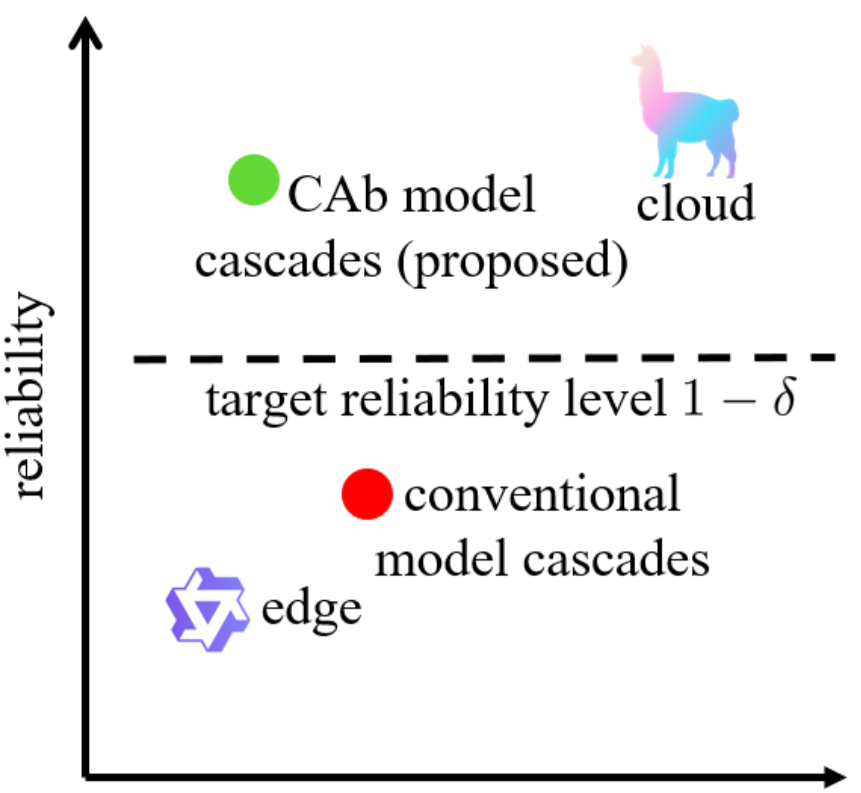
Jiayi Huang, Sangwoo Park, Nicola Paoletti, Osvaldo Simeone Submitted to IEEE Trans. Pattern Anal. Mach. Intell. arXiv / code We study edge-cloud cascades that must preserve conditional coverage: whenever the edge returns a prediction set, it should contain the true label with a user-specified probability, as if produced by the cloud model. We formalize conditional coverage with respect to the cloud predictive distribution, and introduce a conformal alignment-based (CAb) cascading mechanism that certifies this property with user control over the risk level. Our method casts escalation from edge to cloud models as a multiple-hypothesis testing (MHT) problem, tailoring conformal alignment (CA) to select which inputs can be safely handled at the edge. |
|
Jiayi Huang, Sangwoo Park, Nicola Paoletti, Osvaldo Simeone IJCNN, 2025 (oral, invited paper) arXiv / code We propose a novel, low-complexity calibration method specifically designed for edge AI deployment, namely Conformalized Distillation for Credal Inference (CD-CI). |
|
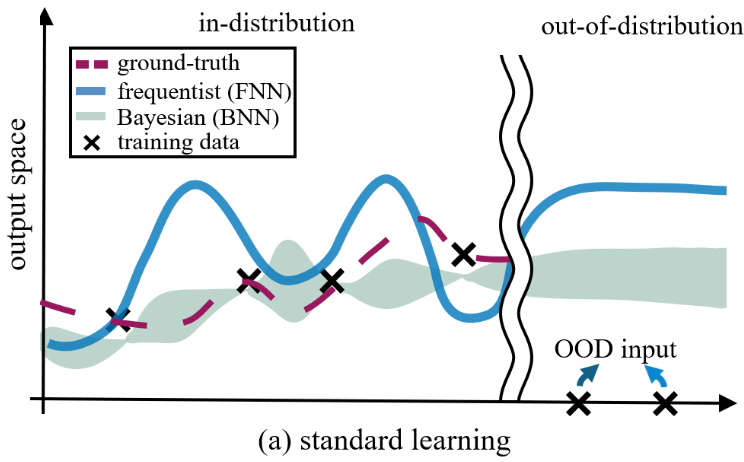
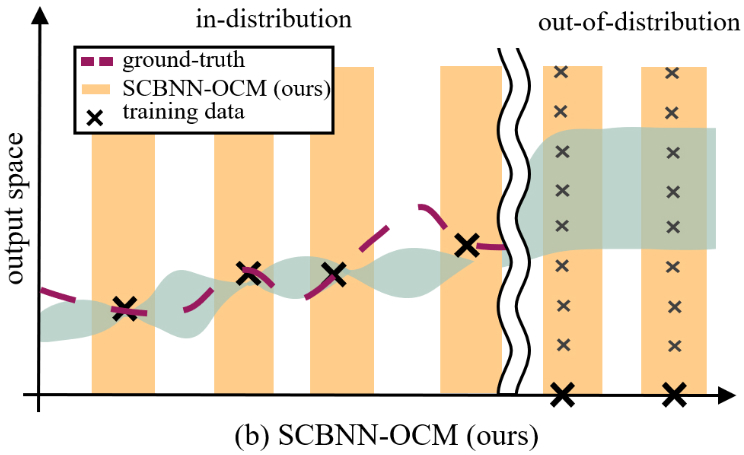
Jiayi Huang, Sangwoo Park, Osvaldo Simeone Accepted by IEEE Trans. Signal Process. arXiv / code A well-calibrated AI model must correctly report its accuracy on in-distribution (ID) inputs, while also enabling the detection of out-of-distribution (OOD) inputs. We propose an extension of VI-based BNN learning that integrates calibration regularization for improved ID performance, out-of-distribution confidence minimization (OCM) for OOD detection, and selective calibration to ensure a synergistic use of calibration regularization and OCM. This approach is termed Selective Calibration-Regularized Bayesian Neural Network incorporating OCM (SCBNN-OCM). |
|
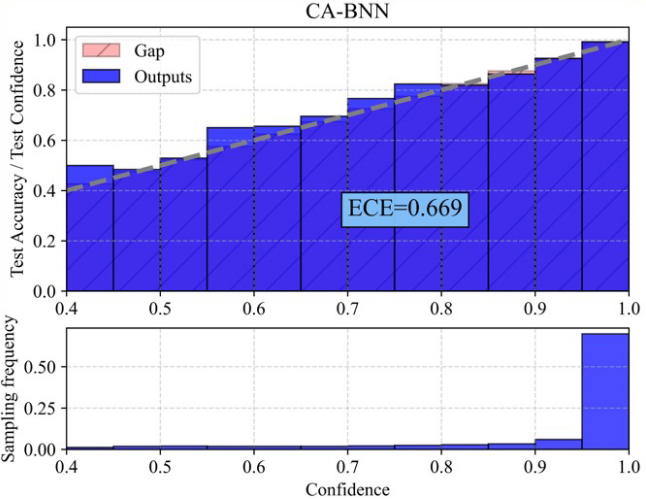
Jiayi Huang, Sangwoo Park, Osvaldo Simeone MLSP, 2023 arXiv / code To quantify epistemic uncertainty, we propose an integrated framework, referred to as calibration-aware Bayesian neural networks (CA-BNNs), that applies data-dependent and data-independent regularizers while optimizing over a variational distribution as in Bayesian learning. |
|
Yep it's another Jon Barron website. |